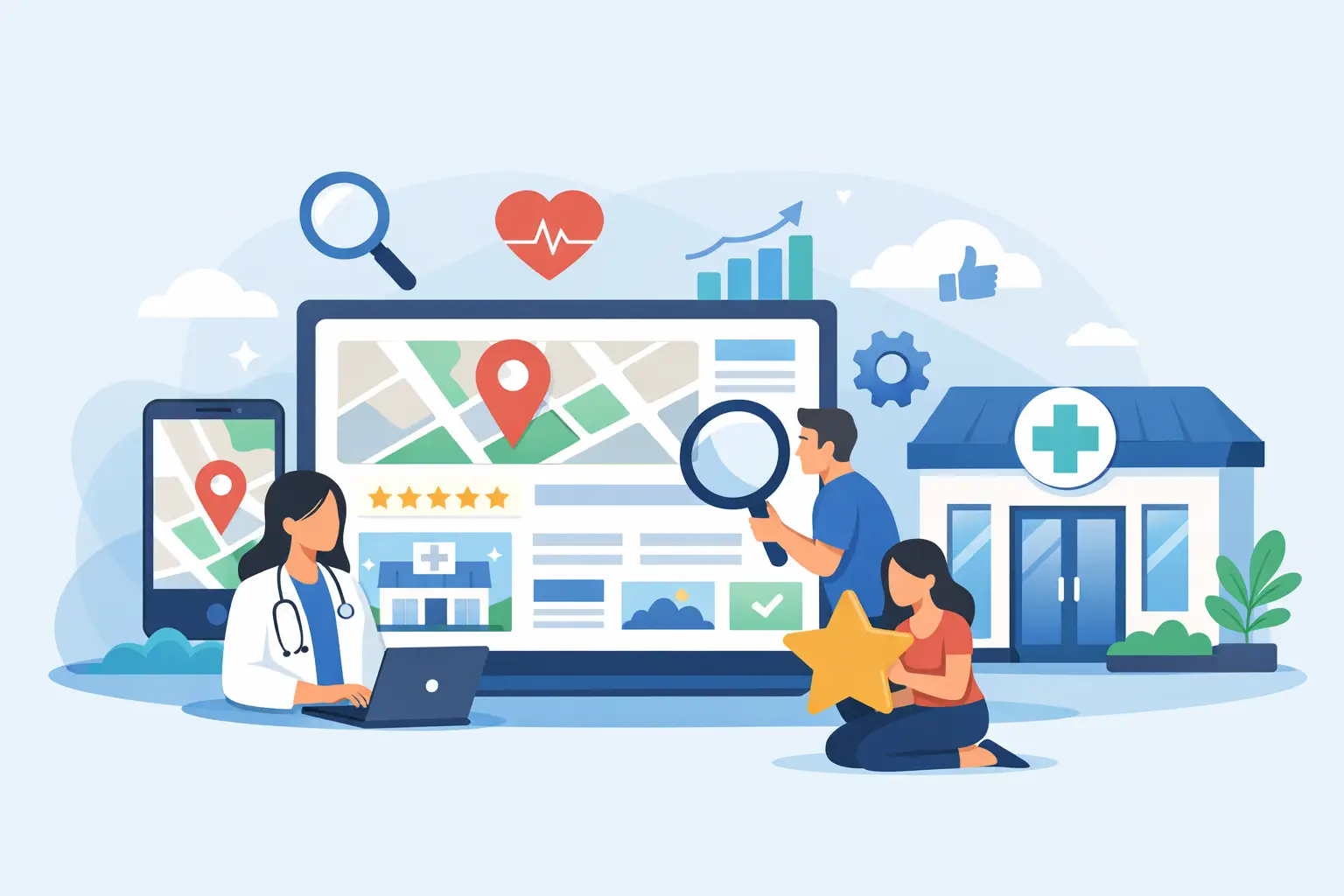
A patient researching cataract surgery, Invisalign or menopause support may no longer begin with a simple Google search. They may ask ChatGPT which specialist credentials matter, use Google’s AI Overview to compare treatment options, or ask Gemini for a clinic near them. AI SEO for healthcare providers is about making sure a practice’s expertise, services and local relevance can be understood and trusted in those moments.
This is not a separate replacement for conventional SEO. It is an extension of the same commercial challenge: being visible when a prospective patient has a genuine need, then giving them sufficient confidence to take the next step. For private clinics, consultants, dental practices and aesthetic providers, that means joining sound search fundamentals with credible medical information, a clear digital presence and a patient journey that does not create unnecessary doubt.
What AI SEO means for healthcare providers
AI search tools are designed to synthesise information rather than simply present ten blue links. They look for sources that appear useful, specific, consistent and well-supported. A response may draw on clinic websites, professional profiles, reputable health publishers, reviews, directories and other established references.
No business can guarantee that an AI platform will mention it in an answer. The systems change, their sources vary, and personalised location or search history can affect what a person sees. The practical objective is more grounded: make it easy for search engines and AI systems to identify who the provider is, what it offers, where it practises, which clinicians are involved and why its information deserves consideration.
For healthcare, this carries more weight than it does for many other sectors. Treatment decisions can affect a person’s health, finances and wellbeing. Search platforms therefore place greater emphasis on signals associated with experience, expertise, authority and trust. Attractive copy alone will not compensate for vague clinician information, thin treatment pages or conflicting details across the web.
AI visibility follows evidence, not clever prompts
There is a temptation to treat generative search as a content volume exercise: publish dozens of short articles that answer every possible question. That can create more pages without creating more authority. Worse, generic or overly certain medical content can damage trust with patients and offer little reason for an AI system to use it.
A better approach starts with the questions patients genuinely ask before booking. Someone considering dental implants may want to understand suitability, recovery, risks, cost factors and the difference between options. A prospective cosmetic surgery patient may need clear, balanced information about consultation, expected outcomes, recovery and when a procedure may not be appropriate.
The clinic website should answer these questions in language that is accurate, readable and appropriately cautious. It should also make clear which information is general education and where an individual consultation is necessary. That distinction is good clinical communication and good search practice.
The foundations of AI SEO for healthcare providers
AI search visibility is rarely improved by one isolated tactic. It comes from a connected set of signals that tells the same coherent story across the website, local listings and wider web.
Clear entities and clinician credibility
A healthcare business needs to be unambiguous online. Its practice name, address, contact details, service locations, clinician names and specialisms should be consistent. Each important clinician should have a properly developed profile, not a name in a footer or a brief sentence on an About page.
Useful profiles explain qualifications, registration where appropriate, areas of clinical focus, relevant experience, professional memberships and the locations where the clinician sees patients. They should be written for patients first, but structured clearly enough for search systems to connect a specialist with the services and topics they are qualified to discuss.
For consultant-led and multi-location organisations, this work is particularly valuable. Search engines need to distinguish between the clinic brand, the individual practitioner, hospital affiliations and service locations. If those relationships are unclear, visibility can become fragmented.
Treatment content that answers the real decision
A strong treatment page is more than a description of what a clinic sells. It should deal with the questions that influence an enquiry: who the treatment may suit, what happens during the process, realistic recovery expectations, risks or limitations, alternatives, pricing context and what to do next.
Not every page needs to cover every subject in depth. A specialist clinic may benefit from a detailed hub of related content, while a smaller dental practice may be better served by improving a smaller number of core service pages. The right scope depends on the treatments offered, local competition, clinical resource and the commercial value of each service.
Content should be reviewed by someone with relevant clinical knowledge. This is especially important where advice could be interpreted as diagnosis or personalised guidance. Clear author and reviewer information can support trust, provided it reflects a real process rather than being added as a cosmetic label.
Technical clarity behind the scenes
AI systems still depend heavily on the same web foundations as Google search. Pages must be accessible, indexable, quick enough to use on mobile and logically organised. Duplicate location pages, broken internal links, inconsistent canonical signals and poorly handled JavaScript can all make it harder for content to be discovered and understood.
Structured data can help search engines interpret details such as organisation information, clinicians, locations, services and frequently asked questions. It is useful supporting infrastructure, not a shortcut to an AI citation. Mark-up must match visible page content and should be implemented carefully, particularly on medical websites where accuracy matters.
A technical audit often identifies simpler, more valuable improvements than a wholesale rebuild. It may be a matter of correcting indexation issues, consolidating near-duplicate pages, improving service-page hierarchy or resolving slow mobile templates. Strategy should determine the work, not a presumption that every website needs replacing.
Local evidence where patients are searching
Many private healthcare decisions remain local, even when the research starts broadly. A patient may research ‘best treatment for varicose veins’ before narrowing the search to a clinic in London, Berkshire or near their workplace. This is where local SEO, Google Business Profile management and AI SEO overlap.
A complete, actively managed business profile, accurate practice details and authentic patient reviews help reinforce local confidence. So do useful location pages that explain the actual service availability, consultant arrangements, travel information and clinic facilities. A page that merely swaps one town name for another is unlikely to help patients or search engines.
Local proof matters. If a clinic serves patients from several areas, demonstrate that through genuine location information, clear directions, consistent listings and relevant local reputation rather than a large set of thin ‘near me’ pages.
Turning visibility into better-quality enquiries
Search visibility has limited value if the website makes a prospective patient work too hard. AI-driven discovery may bring a visitor to a highly specific page with no familiarity with the clinic. They need quick reassurance: who is providing the treatment, what happens next, how to make contact and whether the clinic feels appropriate for their needs.
This is where SEO, user experience and conversion optimisation should be planned together. A treatment page may rank well but underperform because prices are obscured, clinician information is difficult to find, forms ask too much, mobile pages are slow or calls to action feel abrupt. Equally, an enquiry form that produces a high volume of unsuitable leads is not a meaningful success.
Track what happens after the form submission where possible. Enquiries, telephone calls, consultation bookings, attendance rates and treatment value provide a much clearer picture than traffic alone. For practices using paid search alongside organic activity, this insight also shows where advertising can support high-intent demand while longer-term visibility develops.
A sensible starting point
The most productive first step is usually an assessment of the existing picture rather than an immediate AI content programme. Review the service lines that matter commercially, the questions patients ask, current search visibility, local presence, website performance and the path from enquiry to booked consultation.
Four areas tend to deserve early attention:
- Core treatment and clinician pages that are commercially important but thin, unclear or outdated.
- Technical issues that prevent important pages from being crawled, indexed or used well on mobile.
- Inconsistent practice, location or practitioner information across the website and local listings.
- Weak conversion points that waste hard-won visits or create poor-quality enquiries.
The priority will vary. A newer clinic may first need a credible website structure, local foundations and accurate tracking. An established provider may already have strong content but need clearer entity signals, a more usable site or a better connection between organic search, paid media and enquiry handling.
AI search will continue to change how patients research care, but the central requirement is stable: provide useful, evidence-led information from a clearly identifiable healthcare provider, then make it straightforward for the right person to get in touch. If there is uncertainty about where the real constraint sits, a short, no-obligation conversation and an independent review can be a more valuable starting point than another generic list of AI tactics.