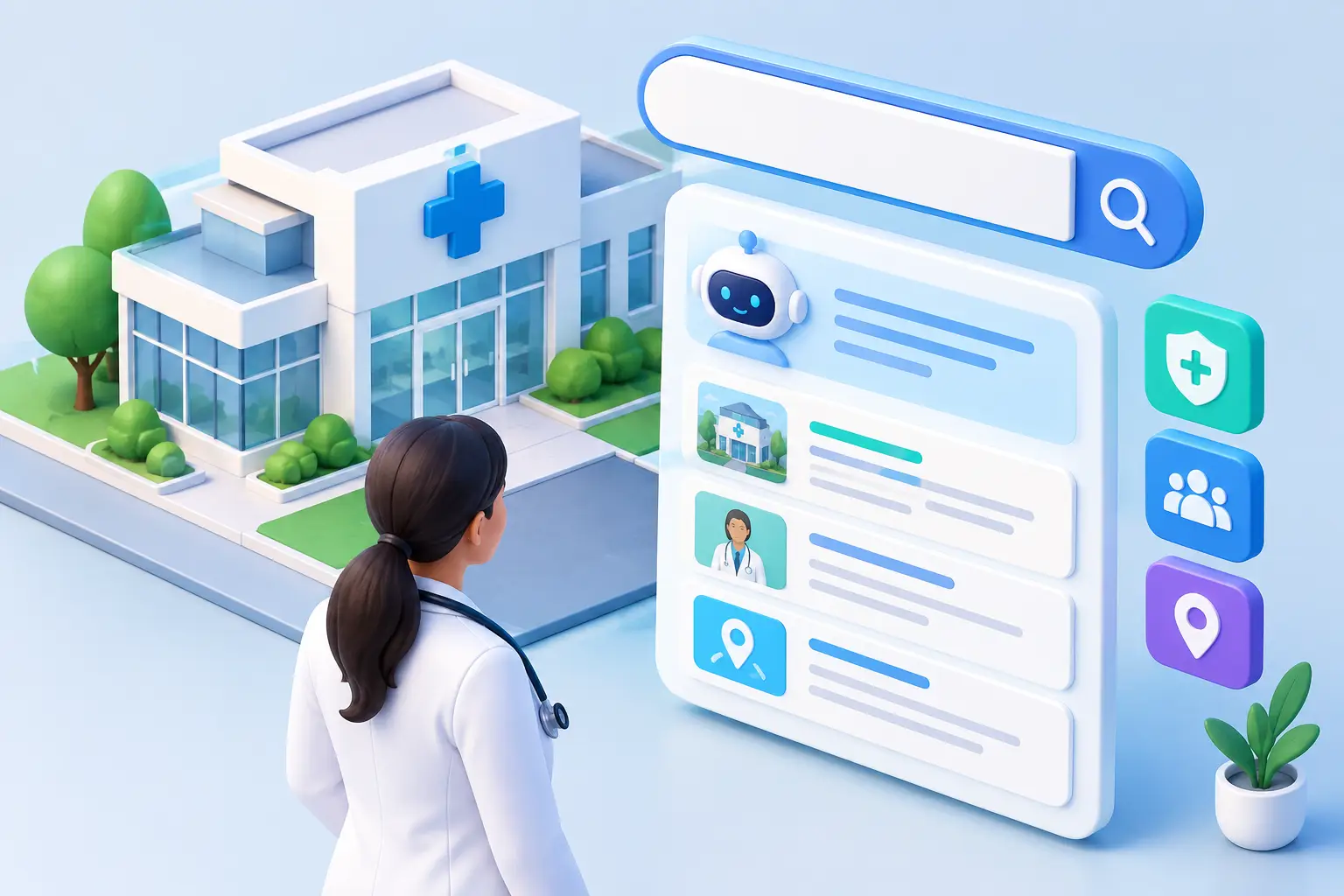
A patient searching “private dermatologist near me” or “dental implants near me” is usually not researching casually. They may be comparing availability, credentials, location, reviews and the ease of booking within a few minutes. Near me SEO for clinics is therefore not simply about appearing on a map. It is about being a credible, convenient choice at the point where local intent becomes an enquiry.
For private clinics, dental practices, aesthetic providers and consultants, this search behaviour has commercial value because it often sits close to a decision. But a prominent map listing alone does not guarantee the right outcome. If treatment information is unclear, the website is slow, the practitioner is difficult to verify or the booking path creates friction, visibility can still fail to turn into appointments.
What near me SEO for clinics actually involves
Google does not rank every nearby healthcare business in the same way. It tries to balance relevance, distance and prominence. Distance matters, but it is not the only factor. A clinic slightly further away may be shown ahead of a closer competitor if Google has stronger evidence that it offers the specific service searched for and is a well-established local entity.
That evidence comes from several places: the Google Business Profile, clinic website, treatment pages, practitioner information, patient reviews, local citations and the wider consistency of the brand’s information online. For healthcare businesses, it is also shaped by trust. Patients and search engines need to understand who provides the treatment, where it is delivered and why the information should be relied upon.
This is why copying a competitor’s category choices or adding “near me” repeatedly to a page rarely produces durable results. The more useful question is whether the clinic has made it easy for Google and prospective patients to connect its services, people, location and credibility.
Start with the searches that lead to the right enquiries
A clinic can rank for broad local terms and still attract the wrong type of enquiry. Someone searching for an NHS service, a low-cost procedure or general advice may not match a private provider’s model. Local SEO should begin with the treatments, locations and patient types that make commercial sense, rather than chasing search volume in isolation.
A cosmetic clinic in Berkshire might need visibility for treatment-specific searches in Slough, Windsor and nearby areas. A London consultant may be better served by searches around a speciality, hospital location and condition rather than a generic city-wide clinic term. Dental practices often need a mix of urgent-intent searches, such as emergency dentist, and considered treatment searches such as Invisalign or implants.
Search intent also changes the page required. A patient looking for a named procedure needs clear information on suitability, practitioner expertise, likely next steps and how to book. A patient looking for a clinic nearby needs reassurance about location, transport, opening hours and accessibility. Combining every service and every location onto one thin page can weaken both relevance and the patient experience.
Build pages around real clinical services and locations
A strong local website structure usually has a well-developed page for each priority treatment or speciality, supported by credible clinic and practitioner pages. Where there is a genuine physical presence or meaningful local relevance, location pages can help patients find the right service.
The qualification matters. Creating near-identical pages for every town in a county, despite operating from one clinic, is unlikely to help long term. It can look manufactured to patients and search engines alike. It is generally better to explain the actual clinic location clearly, identify the areas patients commonly travel from where relevant, and provide useful practical details rather than inventing local relevance.
Each priority page should answer questions a patient would reasonably ask before making contact. This may include the condition or concern treated, who provides the service, treatment options, consultation process, fees or fee guidance where appropriate, risks and aftercare. Healthcare content needs appropriate clinical review and careful wording. Overstated claims may create compliance concerns as well as reduce trust.
Make the Google Business Profile accurate and useful
The Google Business Profile is often the first asset a local patient sees. It should be treated as an extension of the clinic’s patient journey, not a directory listing completed once and forgotten.
The name, address and phone number should match the website and other important business references. The primary category needs to represent the main business accurately, while additional categories should only reflect services genuinely provided. Opening hours, appointment arrangements, website details, photographs and service information should be maintained as the clinic changes.
Photographs deserve more thought than they often receive. Clear, current images of the exterior, reception, consultation rooms and team can reduce uncertainty for a first-time patient. They are not a substitute for clinical evidence, but they make the location feel real and easier to choose.
Reviews also influence both confidence and local prominence. A sensible process asks for genuine feedback after an appropriate point in the patient journey and makes it straightforward for patients to respond. It should never pressure patients, incentivise reviews inappropriately or attempt to shape clinical feedback. Thoughtful, confidential replies demonstrate that the clinic is attentive, while avoiding discussion of personal health information.
Technical foundations still affect local visibility
Many local SEO problems are not content problems. A clinic may have the right treatment pages, but Google may struggle to crawl them, understand the clinic’s locations or decide which page should rank. Common issues include duplicate pages, inconsistent clinic details, poor mobile performance, broken booking links and unclear page titles.
Structured data can help search engines interpret core information about the organisation, local business, doctors and services. It is not a ranking shortcut, and it should accurately reflect what is visible on the site. Used properly, it supports clarity around the clinic as an entity and its relationship with practitioners, treatments and locations.
Mobile experience is particularly relevant for near-me searches. A patient may be on a phone outside a station, at work or after a referral. They should be able to see the clinic address, call the practice, request an appointment and find the relevant practitioner without pinching, waiting or navigating through several unnecessary screens.
Turn local traffic into appointments
Local visibility is only half the job. The website must give a patient enough confidence to take the next step. This is where SEO, user experience and conversion rate optimisation need to work together.
For a complex procedure, a prominent “book now” button may not be enough. Patients may need a clear route to ask a question, arrange a consultation or understand whether the clinic is suitable. For urgent dental care, by contrast, a visible phone number, same-day availability guidance and a direct route to the correct team can be decisive.
Track what happens after the click. Form submissions, calls, booked consultations and qualified enquiries provide a more useful picture than rankings alone. Where consent, privacy and systems allow, clinics should also understand which channels and treatment pages lead to attended consultations and treatment value. This prevents investment being guided by vanity metrics or by leads that never convert.
Paid search can complement organic near-me visibility, particularly for competitive treatments or newly opened clinics. It should not be used to hide weak local foundations. If an advert sends patients to an unclear page with no visible location, pricing context or practitioner information, increasing the budget may simply make an existing problem more expensive.
Local search now extends into AI answers
Patients increasingly ask longer questions in Google AI Overviews and tools such as ChatGPT, Gemini, Copilot and Perplexity. They may ask who offers a treatment nearby, which specialist handles a particular concern, or what to expect from a consultation. These systems rely on many of the same underlying signals as search: clear entities, trustworthy content, consistent business information and evidence of expertise.
That does not mean writing pages for machines or making unsupported claims to appear in an AI response. The practical approach is to publish accurate, clinically reviewed information that clearly identifies the provider, service and location. Well-structured answers, practitioner credentials and reliable technical foundations give both traditional and AI-led search systems stronger material to interpret.
Measure progress without mistaking activity for growth
Near me SEO takes time, especially in competitive London and South East healthcare markets. Results also vary by speciality, location, the clinic’s reputation and the quality of existing digital foundations. A new practice may first need to establish basic trust signals, while an established clinic may be held back by a fragmented website, outdated listings or poor conversion tracking.
The most useful reporting connects map visibility and organic search performance to calls, consultation requests, bookings and enquiry quality. It should also reveal gaps: a treatment page receiving traffic but few enquiries, a profile generating calls outside opening hours, or a location ranking strongly for a service it does not wish to prioritise.
A good local strategy is not about being visible everywhere. It is about being clearly and credibly present when the right local patient is ready to choose, then giving them a straightforward reason to contact the clinic. If it is unclear where that journey is breaking down, an experienced review of search visibility, website experience and enquiry data can often identify the most sensible next step.